
How to Search Berks County Orphans' Court Records
Probate and orphans records in Berks County are reached through the Register of Wills and Orphans' Court online service. The same guest portal that handles marriage applications also covers estate and orphans records. Access to a specific file may require login or a role in the case, since many probate documents carry confidential data.
Before you search, gather the decedent's full name and date of death. For a guardianship or adoption, have the party names and any case detail you know. The office cannot give legal advice, so a clear record description helps staff point you the right way.
- Open the Register of Wills and Orphans' Court online service.
- Log in as a guest or with the access your role allows.
- Search by the decedent or party name and case type.
- Contact the office at 610-478-6600 for files that need staff help.
For marriage records handled by the same office, see the marriage and divorce records page.
The Register of Wills and Orphans' Court Role
The office wears two hats. As Register of Wills, it decides whether a document offered for probate should be received as the decedent's last will. When a probate dispute arises, the Register can act as a quasi-judicial officer, hold hearings, take testimony, and rule on estate administration. As Clerk of Orphans' Court, it keeps the dockets and files for adoptions, guardianships, and other Orphans' Court matters, and it issues marriage licenses.
Suzanne Myers is the Register of Wills and Clerk of Orphans' Court. The contact card below has the office details.
Register of Wills / Clerk of Orphans' Court
Register: Suzanne Myers
Services Center, 2nd Floor, 633 Court Street
Reading, PA 19601
610-478-6600 | Fax 610-478-6251
Mon-Fri 8:30 AM - 4:00 PM
The office is also a permanent keeper of records and a resource for family history research. Because Berks County dates to 1752, its probate and orphans files reach back generations, which makes the office a strong stop for genealogy as well as current estate work. The same counter handles marriage licenses, so a single office covers a wide range of life-event records for the county.
The Virtual Probate Process
Probate in Berks County runs by scheduled virtual appointment. The office does not have electronic filing, so wet signatures are required for all documents. You prepare the paperwork ahead, but you do not sign it until the appointment. The steps below outline the process.
- Locate the decedent's original will and any codicil.
- Prepare the Petition for Grant of Letters, the estate value, and the short-certificate count.
- Gather the death certificate, any consents, and witness oaths if the will is not self-proved.
- Schedule the virtual probate appointment with the Register of Wills.
- Attend the appointment, where signatures are completed.
- Receive the letters and short certificates once the matter is accepted.
After letters are granted, the personal representative administers the estate, handles notice, inventory, debts, inheritance tax, and distributions.
Required Probate Documents
The office is clear about what must be ready before the appointment. Bringing the wrong or unsigned documents can stall the case. The list below covers the core items for opening an estate.
- The decedent's original will and any codicil.
- A completed Petition for Grant of Letters, left unsigned until the appointment.
- The estate value and the number of short certificates needed.
- A death certificate.
- Witness oaths if the will is not self-proved.
Clerks cannot give legal advice or complete estate documents. Only Pennsylvania licensed attorneys may represent a person before the office, and the Bar Association Lawyer Referral Service can be reached at 610-375-4591.
Short Certificates and Letters
Two terms come up constantly in probate. Letters are the document that appoints the personal representative and gives them authority over the estate. Short certificates are proof of that authority, used to deal with banks, agencies, and other parties. The petition asks how many short certificates you need, so estimate the institutions you will contact.
A self-proved will can skip the separate witness oath step. If the will is not self-proved, the office needs witness oaths before it can proceed. These details decide how smooth the appointment goes. It helps to estimate the number of short certificates carefully, since each bank, insurer, retirement plan, or agency may want its own. Asking for too few means a return trip, while a reasonable count keeps the estate moving without waste.
Berks County Probate Fees
The Orphans' Court and Register of Wills publish a fee schedule that covers estate and orphans categories. One commonly used fee is the marriage certification at $5. Probate filing and short-certificate amounts are set in that official fee schedule, so confirm the current figures before you pay.
| Item | Amount |
|---|---|
| Marriage certification | $5 |
| Probate filing and short certificates | See official Orphans' Court fee schedule |
The office also serves as the Commonwealth's agent for inheritance tax, so inheritance tax returns and payments connect to the estate file.
Probate Terms Defined
Probate uses words that trip up many families. A short glossary clears them up before you read a file or fill a form.
- Testator
- The person who made the will.
- Executor
- The personal representative named in a will to settle the estate.
- Intestate
- Dying without a valid will, so state law decides who inherits.
- Guardianship
- A court arrangement to care for a minor or an incapacitated adult.
- Conservatorship
- Court authority to manage another person's property or finances.
Disputed Probate and Will Contests
Most probate is routine, but not all of it. When someone challenges a will or an estate decision, the Register of Wills can act in a quasi-judicial role. The Register may hold a hearing, take testimony, review the evidence, and render a decision on estate administration. That power lets the office resolve many disputes without sending them straight to a judge.
Some questions still need a full judicial answer. Those move to the Orphans' Court, which decides estate matters that require judicial disposition, along with guardianships and adoptions. A party who disagrees with a ruling has appeal rights through the Pennsylvania court system. Because these matters can turn on legal detail, the office refers people to licensed attorneys rather than offering advice.
Inheritance Tax and the Register of Wills
The Register of Wills also serves as the Commonwealth's agent for inheritance tax. That means the estate's inheritance tax return and payment connect directly to the probate file opened in Berks County. The personal representative handles the return as part of administering the estate, alongside the inventory, debts, and distributions.
Inheritance tax is separate from any federal estate tax and follows Pennsylvania rules. Because the amounts and rules change, an estate with tax questions should confirm the current figures with the Department of Revenue or an attorney. The Register's office can accept the filing but cannot give tax or legal advice.
Guardianships and Adoptions
The Orphans' Court handles guardianships and adoptions along with estates. Guardianship matters protect minors and incapacitated adults. Adoption cases create new legal parent-child relationships. Adoption records, though, are confidential. Pennsylvania adoption law treats these as permanent records that are withheld from inspection except by court order or as the statute allows.
You can read the adoption confidentiality rules in the statute.
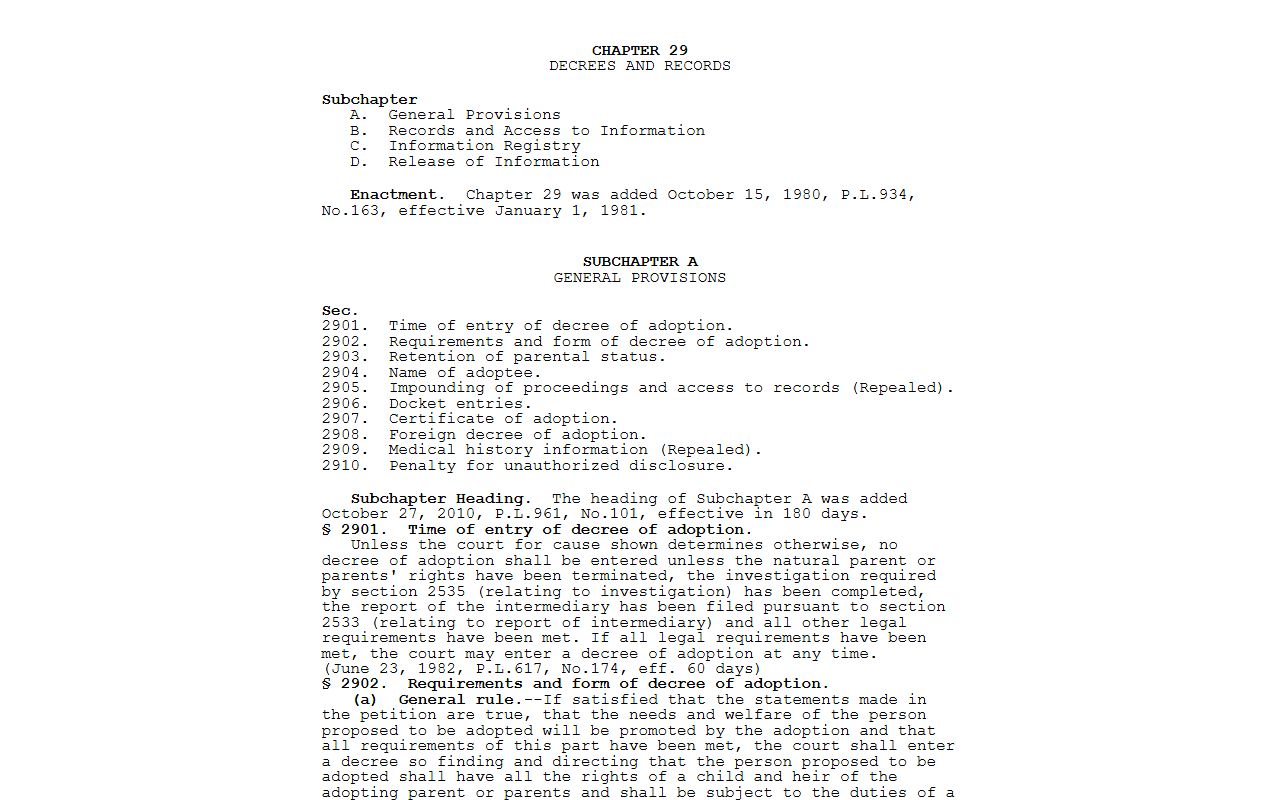
The Pennsylvania adoption records chapter is why adoption files are not part of an ordinary public search.
Opening and Administering an Estate
Once letters are granted, the estate moves into administration. The personal representative gathers assets, gives required notice, pays valid debts and taxes, and distributes what remains. Disputed questions can move from the Register to the Orphans' Court for a judicial decision. The county's probate and estates page lays out the appointment requirements.
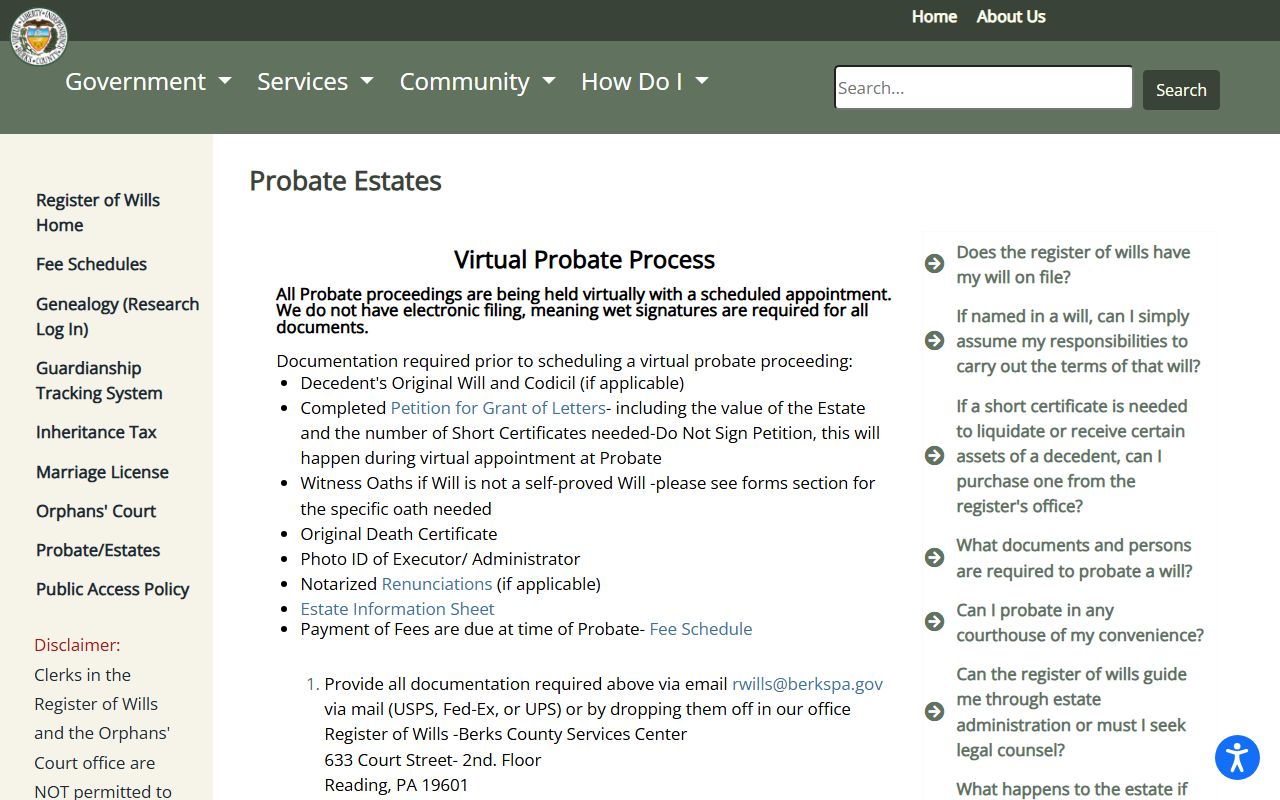
The probate and estates page covers the virtual appointment and the documents needed to begin.
Orphans' Court Public Access Rules
Orphans' Court filings follow the Unified Judicial System Public Access Policy, effective January 6, 2018. Filers who include personal information must file a Confidential Information Form with a redacted copy. Filers who submit confidential documents must file a Confidential Document Form with the unredacted version. Parties may not file both a redacted and an unredacted version of the same document.
The county posts the public access notice for these filings.
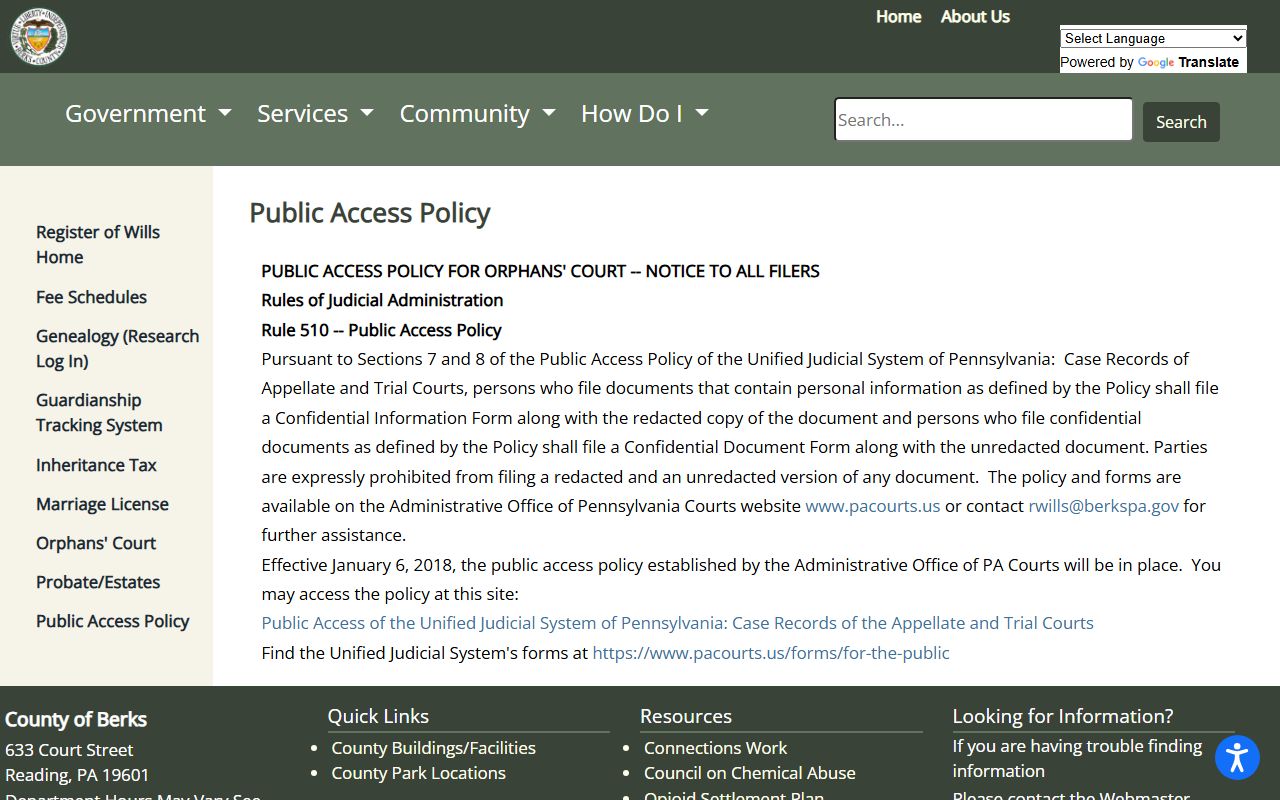
The Orphans' Court public access policy page links the required forms. These rules protect sensitive estate, guardianship, and adoption details while keeping the rest of the record open to the public. For broader records, see public records and the Prothonotary for civil court files.