
About the Berks County Clerk of Courts
The Clerk of Courts is the criminal record keeper for the Court of Common Pleas. The elected Clerk is Beth A. Jones, with Beth A. Hartman as Chief Deputy. The office mission is to serve the court and the public in the administration of misdemeanor, felony, and criminal matters under court order and state law. It is on the 4th floor of the courthouse.
Berks County Clerk of Courts
Clerk: Beth A. Jones
Courthouse, 4th Floor, 633 Court Street
Reading, PA 19601
610-478-6550
Mon-Fri 8:00 AM - 4:30 PM
The payment window keeps the same weekday hours, though in-person credit card payments are not taken after 4:00 PM. The office team also includes an Office Manager, an Administrative Assistant, and a Solicitor, who support the day-to-day work of maintaining the criminal court records and handling the financial side of each case.
What the Berks County Clerk of Courts Does
The Clerk of Courts handles the paperwork and the money of the criminal court. It prepares and maintains the records, keeps the court's seal, and tracks every dollar of fines and costs. The duties below cover the core of the office.
- Prepare and maintain criminal records for the Court of Common Pleas.
- Sign and seal writs and process, and administer oaths and affirmations.
- Keep the seal and records of the court, and certify and distribute court orders.
- Prepare bills of costs for defendants.
- Use a computerized system to disburse fines, costs, and restitution.
That financial role makes the Clerk the office to contact about a balance, a payment plan, or a bill of costs on a criminal case.
Criminal Records the Clerk of Courts Keeps
The Clerk of Courts holds the criminal files once a case reaches the Court of Common Pleas. Most criminal cases begin before a magisterial district judge, then move to Common Pleas if they are held for court. From that point, the Clerk maintains the docket and the file. The list below shows the records the office keeps.
- Misdemeanor and felony Common Pleas criminal cases.
- Sentencing orders and other court orders.
- Bills of costs prepared for defendants.
- Fines, costs, and restitution records.
- Writs and process signed and sealed by the office.
Public criminal dockets are generally searchable through the statewide portal unless they are sealed, expunged, juvenile, or under Clean Slate limited access. The Clerk holds the underlying file even when the public docket is limited. That is why a docket sheet found online still points you back to this office for the certified copies and the full record behind the summary.
How to Request Criminal Court Copies
Certified copies of criminal records come from the Clerk of Courts. People need them for appeals, background matters, and proof of a disposition. Start by finding the case, then bring the docket number to the office. The steps below outline the request.
- Locate the criminal docket on the statewide court portal.
- Note the CP docket number and the parties.
- Contact or visit the Clerk of Courts on the 4th floor.
- Identify the document and the number of certified copies.
- Pay any copy fee and pick up or receive the copy.
To find the docket first, the court records and arrest records pages cover the portal and the criminal case path.
Records Request Information
To pull a criminal record, the office needs enough detail to find the right case. A docket number is best, but names and identifiers help too. The table below shows what to bring.
| Field | Required | Notes |
|---|---|---|
| Docket Number | Helpful | A CP criminal number is the cleanest way to find a case |
| Party Name | Yes | The defendant's name as it appears on the case |
| OTN or Complaint Number | Helpful | Useful identifiers on criminal cases |
| Document Type | Yes | Order, sentence, bill of costs, or full docket |
| Number of Copies | Yes | Certified copies may carry a fee |
For a straightforward criminal record, an oral request to the custodian may be enough; a complex one may require writing.
Paying Fines, Costs, and Restitution
The Clerk of Courts handles payment of court fines, costs, and restitution on Common Pleas criminal cases. You can pay in person at the payment window, by mail, or online. Mailed payments go by check or money order to the Central Collection Bureau, care of the Clerk of Courts, with the docket number written on the payment.
Online payment runs through the statewide PAePay system.
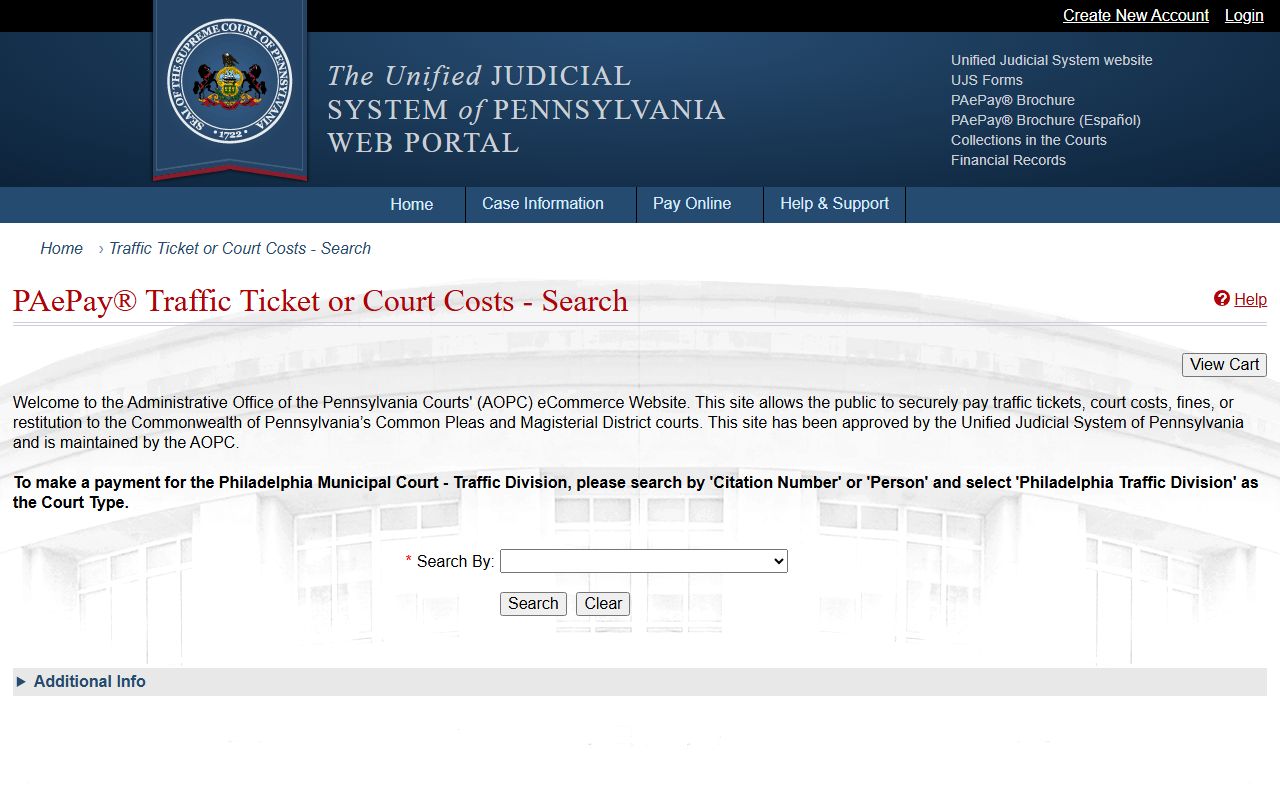
The PAePay portal lets you pay traffic tickets and court costs online, with a $2.75 convenience fee added to the total.
Clerk of Courts Payment Rules
A few payment rules trip people up, so it helps to know them before you pay. Credit cards are accepted in person and online, but not by phone. The office takes Visa, Mastercard, and Discover. The table below sums up the main points.
| Item | Detail |
|---|---|
| Online convenience fee | $2.75 added through PAePay |
| Cards accepted | Visa, Mastercard, Discover |
| Phone payments | Not accepted by phone |
| In-person card cutoff | No card payments after 4:00 PM |
Always write the docket number on a mailed payment so the office can credit the right case.
Bills of Costs and Financial Records
A criminal case often ends with more than a sentence. The court can impose fines, court costs, and restitution to victims. The Clerk of Courts prepares the bill of costs for the defendant and tracks the balance through a computerized financial system. That system records each payment and the remaining balance on the case.
This financial role is why the Clerk is the office to call about a payment plan or an outstanding balance on a criminal case. A docket may show the totals, but the Clerk holds the working account. If a case shows an unpaid balance, clearing it usually runs through this office rather than the court itself. Restitution collected here is then disbursed to the people the court ordered it for.
How Criminal Cases Reach the Clerk
A criminal case does not start at the Clerk of Courts. It usually begins with an arrest and a complaint filed before a magisterial district judge. That judge handles the preliminary arraignment, sets bail, and holds the preliminary hearing. If the judge finds enough basis, the case is held for court and moves up to the Court of Common Pleas.
At that point a Common Pleas criminal docket opens, and the Clerk of Courts takes over the file. The case may show both an MJ docket from the district level and a CP criminal docket from Common Pleas. The Clerk then carries the case through plea or trial, sentencing, and any financial obligations. Understanding this path explains why a search sometimes turns up two linked dockets for one matter, a point covered on the court dockets page.
Expungement Orders and the Clerk
The Clerk of Courts plays a key role in clearing a record. When a court signs an expungement order, the Clerk processes the criminal file and the signed order. The Pennsylvania State Police then expunge the record from the state criminal history once they receive that order. The process reaches Pennsylvania records, not federal or out-of-state ones.
A person seeking expungement or limited access files in the Court of Common Pleas where the case occurred. The Clerk handles the file side of that process. For the eligibility rules and the difference between expungement and Clean Slate limited access, see the arrest records page.
Federal Criminal and Bankruptcy Cases
The Clerk of Courts handles county criminal cases, not federal ones. Federal criminal cases from Berks County go to the U.S. District Court for the Eastern District of Pennsylvania. Bankruptcy is separate again, handled by the U.S. Bankruptcy Court for the Eastern District, which has a Reading office. Neither is kept by the county Clerk.
The federal bankruptcy court publishes its own case tools online.
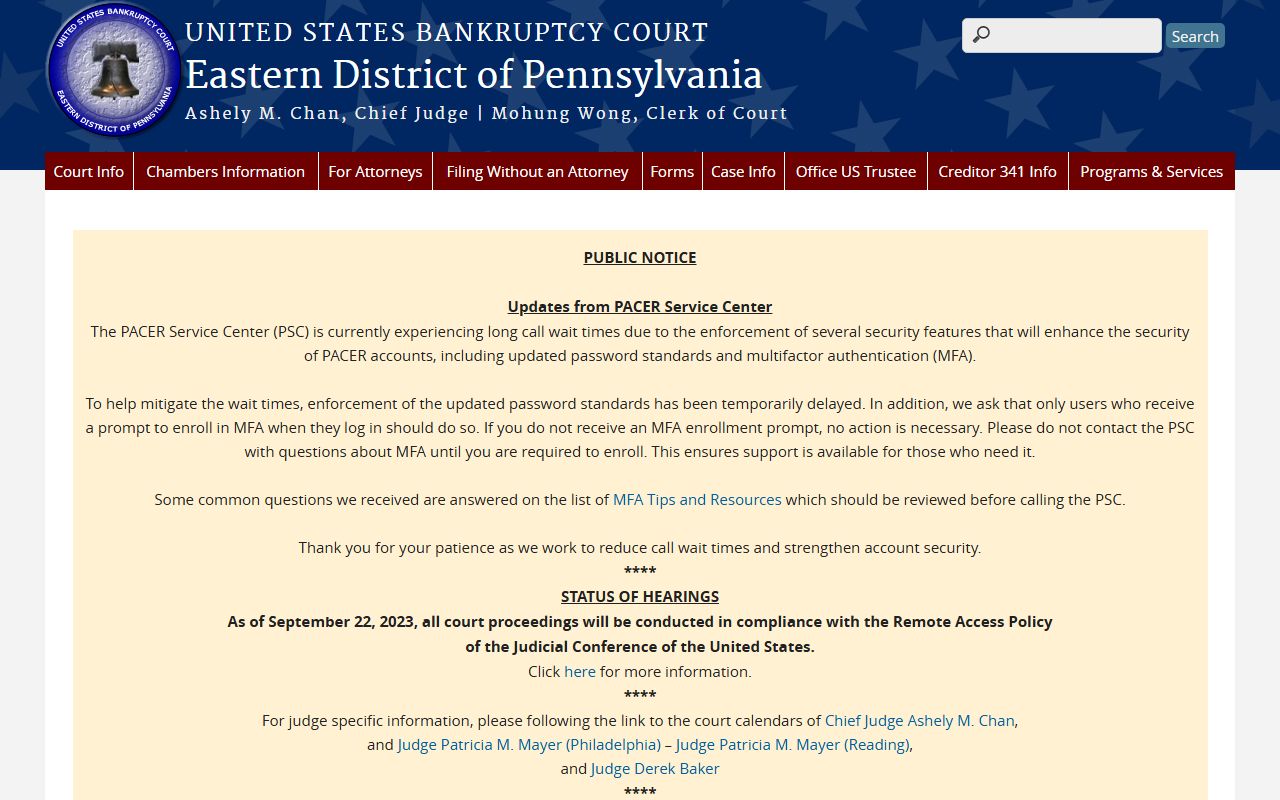
The Eastern District Bankruptcy Court handles federal bankruptcy matters that the county Clerk does not. Federal dockets in general run through PACER.
Clerk of Courts vs Prothonotary
Berks County splits its court records between two clerks, and the names do not make it obvious. The Clerk of Courts keeps criminal records. The Prothonotary keeps civil and family records. The comparison below makes the split clear.
| Clerk of Courts | Prothonotary | |
|---|---|---|
| Records | Criminal | Civil and family |
| Examples | Felonies, fines, costs | Divorce, judgments, liens |
| Floor | 4th floor courthouse | 2nd floor courthouse |
| Phone | 610-478-6550 | 610-478-6970 |
For the civil side, see the Berks County Prothonotary page, and for the trial court, the Court of Common Pleas page.